

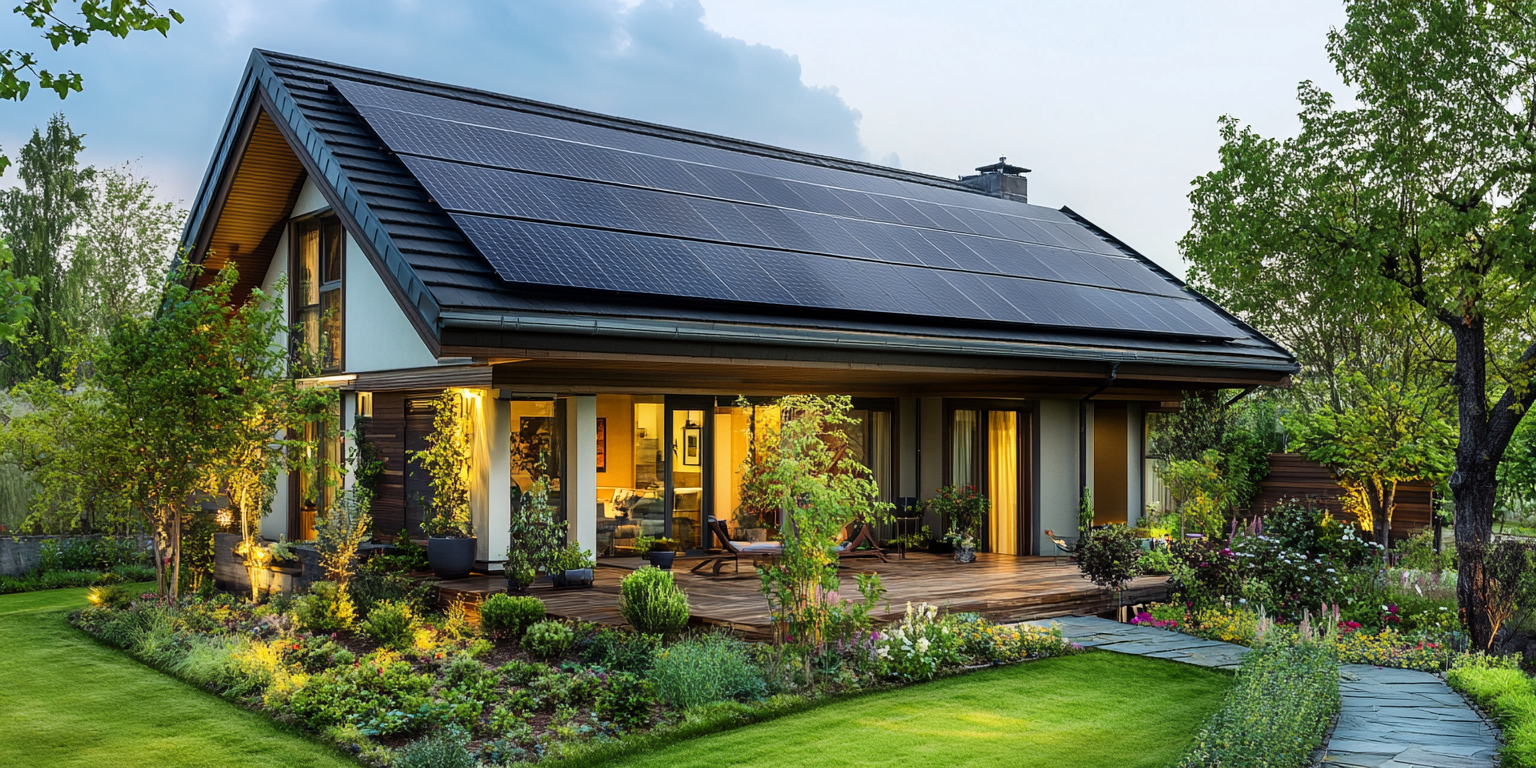
For most projects today, specify monocrystalline modules and choose the inverter architecture by shade, roof complexity and rapid shutdown, not by brand loyalty. Modern modules lose about 0.5% of output per year on median, so a 25-year performance warranty that guarantees 88% to 92% is realistic, and the labor terms matter more than the headline percentage. String inverters cost less per watt and suit simple, unshaded arrays. Microinverters and optimizers cost more and earn it on shaded, multi-plane or expanding systems, and they are the usual route to module-level rapid shutdown.
Key takeaways
- Monocrystalline silicon is the default choice for new quotes, with polycrystalline largely gone from new product and thin film mostly a utility-scale technology.
- NREL's review of nearly 2,000 field measurements found a median degradation rate of 0.5% per year and a mean of 0.8%, so a module warrantied near 88% to 92% at year 25 is typical for current product.
- Bifacial gain depends on the ground: modeling found under 10% at an albedo of 0.25 and about 30% only with an albedo near 0.5 and modules a meter off the ground.
- Module-level electronics recovered 25 to 35% of shading losses in NREL's testbed, and they are the common way to meet the 80 V module-level limit in the 2020 NEC.
- Read warranties for labor, claimant, connectivity and transfer terms: the Enphase US warranty covers a replacement microinverter for 25 years but excludes the labor to remove and reinstall it.
- For 2026 construction starts claiming the §48E credit, foreign-entity sourcing rules can decide the brand before efficiency does.
What are the differences between monocrystalline, polycrystalline and thin-film panels?
Monocrystalline modules use cells cut from single-crystal silicon and are the standard choice for rooftop and most ground-mount work. Polycrystalline (multicrystalline) modules use cast silicon and cost less per cell but convert less sunlight, and most manufacturers have largely stopped making them. Thin film deposits a very thin semiconductor layer on glass or a flexible substrate and is mainly a utility-scale technology in the US.
| Type | Typical commercial efficiency | Where it fits | Watch for |
|---|---|---|---|
| Monocrystalline (PERC, TOPCon, heterojunction, back-contact) | roughly 20 to 24% | Residential, commercial roof and ground | Price differences between cell types, not between "mono" and "poly" |
| Polycrystalline | lower, mostly older product | Existing arrays, legacy replacement | Availability for matching modules in repairs |
| Thin film (CdTe, CIGS, amorphous silicon) | lower than crystalline silicon | Large ground-mount arrays, light-weight or curved surfaces | Lower power per square foot, so more area and racking per kW |
Efficiency matters when roof area is the limit and matters less when the roof has room and the budget is tight. Compare power per module, power per square foot, cost per watt and the power temperature coefficient, which is how much output falls per degree Celsius above 25. Florida roofs run hot, so a lower coefficient helps summer yield. Generalizations such as "mono resists heat better" or "thin film lasts 10 to 20 years" depend on the specific product, so choose by datasheet and warranty.
How fast do modern solar panels degrade?
About 0.5% per year at the median. NREL's analytical review of nearly 2,000 reported rates from 40 years of field testing found a median of 0.5% per year and a mean of 0.8%, with 78% of the data below 1% per year. That review also found thin-film rates were closer to 1% per year when it was published in 2012, though it noted rapid improvement.
At 0.5% per year a system retains roughly 88% of its output after 25 years. At 0.8% it retains about 80%. Most modules also lose a small amount in the first hours of sunlight, which PVWatts models as a 1.5% light-induced degradation default, and then follow the long-term rate.
What to do with this:
- Use a realistic rate in the production model. Use 0.5% per year, or 0.8% for conservative financial models.
- Compare the warranty curve to the modeled one. A warranty that guarantees 92% at year 25 is a stronger claim than one that guarantees 80%, and the older 80% at year 25 figure is now the weak end of the range. REC, for example, lists 92% minimum power in year 25 on its Alpha Pure series.
Heat, UV, humidity and installation damage push the rate up, and monitoring is how you catch an outlier. The sizing and production guide shows where degradation enters the energy model.
Do bifacial panels change how you design the system?
They change the layout and the weight, and the gain only shows up on the right site. A bifacial module collects light on its back as well as its front. In a global modeling study by NREL and Purdue, ground-mounted bifacial gain stayed under 10% at a ground albedo of 0.25, and rose to about 30% only at an albedo of 0.5 with modules mounted 1 m off the ground.
That makes bifacial worth a close look on:
- Ground mounts and trackers with light-colored ground cover or gravel.
- Flat commercial roofs with white membranes and enough clearance under the modules.
- Carports and canopies, where light reaches the back from below.
It adds little on a flush-mounted pitched roof, where the back of the module sits a few inches off a dark shingle. For design, set the albedo and mounting height in the energy model, space rows so one does not shade the back of the next, and check module weight. Many bifacial modules use glass on both sides and weigh more than glass-and-backsheet modules, which matters for existing roof capacity and racking loads. The 30% figure in older posts and marketing applies to ideal conditions, not average ones.
Microinverters, string inverters or optimizers: which fits?
Choose a string inverter for simple, unshaded roofs and large commercial arrays, microinverters for complex or shaded residential roofs, and optimizers with a string inverter when you want module-level control and a single central inverter.
| Architecture | Where it fits | Strengths | Trade-offs |
|---|---|---|---|
| String inverter | Single-plane roofs, ground mount, commercial | Lowest cost per watt, simple, easy to service at one location | One shaded module drags its string unless bypassed, no module-level data, usually needs a separate rapid shutdown device |
| String inverter with DC optimizers | Shaded or multi-plane roofs, where you want one inverter | Module-level shutdown and monitoring, tolerant of mismatch | Optimizers add cost and parts on the roof |
| Microinverters | Small, shaded or complex residential roofs, systems that will expand | Each module operates independently, AC wiring on the roof, easy to add modules | Highest cost per watt, inverters live in roof heat, replacement means roof access |
Microinverters are not automatically more efficient: the benefit appears on shaded or mismatched arrays and disappears on a clean, uniform one. Nor are string inverters automatically more reliable in heat. Warranty terms are a better guide than a rule of thumb.
On service, NREL's O&M best practices report notes that a microinverter failure has an incremental effect on production and can wait for a scheduled visit, while a string inverter failure takes the whole array offline and warranty replacement of a string inverter can take about a month. That is a design input for customers who care about downtime.
For expansion, microinverters make adding modules simple. String inverters need spare input capacity or a second inverter, and mixing module types on one string costs output.
When is module-level power electronics (MLPE) necessary?
MLPE, meaning microinverters or DC optimizers, is necessary when the code requires module-level rapid shutdown, when shade or roof-plane mismatch will cost real energy, and when the customer wants module-level monitoring. It is optional on clean, single-plane, unshaded arrays.
The first reason is often the deciding one. Under the 2020 NEC (adopted by the Florida Building Code, 8th Edition) until December 30, 2026, and the 2023 NEC under the 9th Edition, scheduled to take effect December 31, 2026, rooftop PV on buildings needs a rapid shutdown system. In the 2020 NEC, section 690.12 defines the array boundary as 1 ft around the array, limits conductors outside it to 30 V within 30 seconds, and limits conductors inside it to 80 V within 30 seconds, unless a listed PV hazard control system is used. Module-level devices are the usual way to meet the inside-the-array limit. Elsewhere, design to the NEC edition your jurisdiction has adopted, and confirm the requirement with the AHJ. The NEC compliance guide covers the rest of the code checklist.
The second reason is energy. NREL and PV Evolution Labs tested equipment from four manufacturers and found that module-level electronics recovered 25 to 35% of annual shading losses. On a roof with 5% shade loss that is worth a point or two of output. On a roof with 20% shade loss it is meaningful. Show the customer the numbers instead of a blanket recommendation.
The third reason is complexity: three roof planes with different orientations suit microinverters and strain one string inverter.
What warranties come with panels, inverters and racking?
Expect two warranties on a module (product and performance), a separate warranty on the inverter, and a third on the racking, plus the installer's own workmanship warranty. They are written by different parties and usually do not cover labor.
| Component | Typical coverage | Questions to ask |
|---|---|---|
| Modules, product warranty | Defects in materials and workmanship, often 10 to 25 years | Is it a manufacturer or an installer claim? Does it cover shipping and labor? |
| Modules, performance warranty | Guaranteed minimum output at year 25 or 30, commonly linear | What is the year-one and year-25 floor, and is the decline linear or stepped? |
| String inverters | Commonly 10 to 12 years, often extendable | Is the extension offered, and who pays for the truck roll? |
| Microinverters and optimizers | Up to 25 years on current lines | Does the warranty require ongoing internet connectivity? |
| Racking | Often 10 to 25 years on structure and finish | Does it cover corrosion, and does installation by an approved installer void it? |
| Installer workmanship | Frequently 1 to 10 years | Does it cover roof leaks at penetrations, and who handles the roofer's warranty? |
NREL's O&M report distinguishes product warranties from performance warranties, and notes that EPC and installer warranties may be as short as 1 to 5 years while module equipment warranties can run 25. It recommends that equipment warranties transfer to the responsible O&M provider when the installer's warranty ends.
One example of the details: the Enphase US limited warranty lists IQ microinverters at 25 years from activation, expects the devices to stay connected to the internet, and states that it does not include labor to uninstall, reinstall or troubleshoot. A free replacement unit is not a free service call.
How do you compare brands of panels and inverters?
Compare listings, data sheets, warranty terms and supply, in that order, then price. Efficiency is one line on that list.
A short checklist for contractors:
- Listings. Modules should carry UL 61730 or an equivalent safety certification and inverters UL 1741. If you rely on a listed rapid shutdown system, check that the combination is listed for it (UL 3741 covers PV hazard control).
- Datasheet numbers. Power per module, temperature coefficient, first-year and annual degradation, maximum system voltage, and weight and dimensions for the structural calc.
- Warranty. Check the claimant, the transfer terms, the labor terms and whether the warranty applies at the project's location.
- Manufacturer stability. A warranty is only as good as the company still standing in year 12, so weigh track record and keep the registration paperwork.
- Local rules. Florida exempts solar systems and components from sales tax (§212.08(7)(hh)), and the Florida Solar Energy Center certifies equipment.
For projects that claim the §48E credit, equipment sourcing is its own filter. Material-assistance rules apply to §45Y and §48E facilities and storage that begin construction after December 31, 2025, with a minimum material-assistance cost ratio of 40% for qualified facilities and 55% for storage when construction starts in 2026. Notice 2026-15 sets interim safe harbors for showing it. The §25D homeowner credit ended for expenditures after December 31, 2025, so this filter applies to commercial and third-party-owned systems, not homeowner-owned ones. See is FEOC-compliant equipment actually available before you lock in a module supplier.
Which new solar technologies matter for projects today?
None that should change a plan set this year. Perovskite and perovskite-silicon tandem cells have posted lab records, but record cells are not products. The national lab's cell-efficiency chart tracks the highest confirmed efficiencies for research cells measured by independent labs, not what a module delivers on your roof. Stability, certification and bankability take years.
What does matter is the shift in mainstream crystalline silicon from older cell types to n-type designs such as TOPCon, heterojunction and back-contact, which typically offer higher efficiency and better temperature behavior on current datasheets. Bifacial, floating solar, building-integrated PV and solar windows are real but niche, and each fits a specific site. Specify only what carries a listing and a warranty you can read.
FAQ
Is polycrystalline still worth buying?
Only to match existing modules in a repair or expansion. New quotes are almost entirely monocrystalline.
Do I have to use the same brand of panel and inverter?
No. Panels and string inverters are interchangeable as long as voltage, current and MPPT windows match. Microinverters and optimizers have module compatibility lists, so check them. Using one vendor for panel and inverter does make a warranty claim simpler.
Should customers pay extra for a longer inverter warranty?
Often yes for string inverters. Replacement is the most likely major cost in the system's life, and a 10 to 12 year coverage period ends before the modules do. Whether the extension is worth it depends on the price and on whether it covers labor.
Do solar panel warranties cover roof damage?
No. A module or inverter warranty covers the equipment. Roof leaks at penetrations are an installer and roofer issue, and the roof's own warranty may require notice or an overburden waiver, as NREL's O&M report points out.
Bottom line
Specify monocrystalline modules, model degradation at 0.5% per year, and choose the inverter by shade, roof geometry and rapid shutdown requirements. Read each warranty for what it excludes, especially labor, and keep registration paperwork with the project file. For commercial and third-party-owned projects claiming the credit, check sourcing before you commit to a supplier.
SunSmart Engineering designs and stamps PV plan sets for contractors in all 50 states.
Keep reading.
Have a project in mind?
Tell us what you're building and we'll help you get it engineered, sealed, and permitted.